Data Center Site Selection in Mexico vs. the U.S.
Data center site selection runs in the same order on both sides of the border: power first, then water, land, fiber and permits. In Mexico, three extra questions can kill a deal before price comes up: who holds the land, whether the water can legally be used, and how long CFE takes to connect the site.
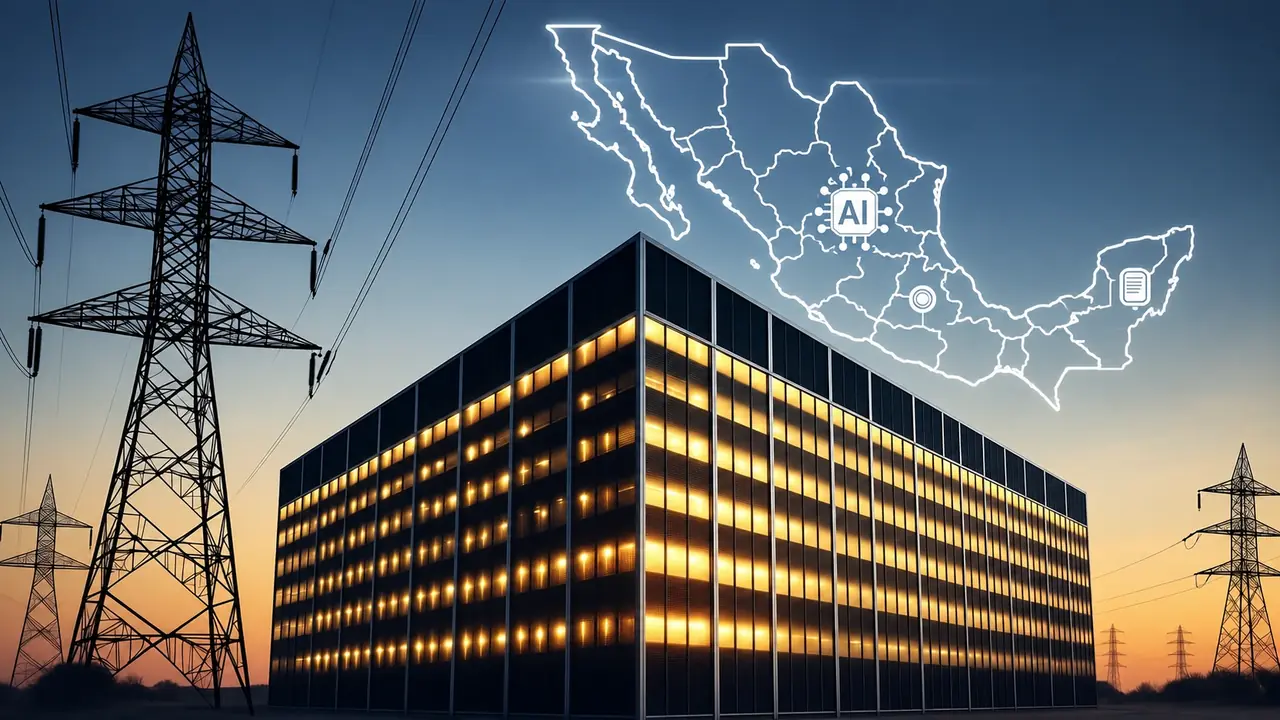
The short version: Mexico has about 279 MW of data center capacity operating, 205 MW under construction and 1,730 MW announced, and about 72% of it is in Querétaro (MEXDC, 2026). The constraint is the grid: large loads can wait about five years for power. Since December 2025, agricultural water concessions cannot be sold or converted to industrial use. Ejido land can host a data center only through a lease (up to 30 years, extendable), a contribution to a company, or conversion to private title.
This is the condensed version. The full guide covers the Mexico-vs-U.S. comparison table, power law, the 2025 water law, foreign ownership, ejido paths, permits, markets, three scenarios with the math, eight mistakes, 25 FAQs and sources. Read it at passive.investments/data-center-site-selection-mexico.
Mexico vs. the U.S. at a glance
| Factor | Mexico | United States |
|---|---|---|
| Time to power | ~5 years for large loads; 60%+ of transmission near capacity | Dominion (VA) averages ~7 years; Texas SB 6 adds large-load rules |
| Water | CONAGUA concessions; no private transfers or ag-to-industrial change since Dec 2025 | State water law; generally transferable with the land |
| Land tenure | Private, ejido or comunal; restricted zone near borders and coasts | Fee simple |
| Main markets | Querétaro (~72%), Mexico City, Monterrey, Guadalajara | N. Virginia, Texas, Phoenix, Atlanta, TVA region and more |
| Land signal | Monterrey industrial ~US$500–700/m² (built product) | Loudoun ~$6.3M/acre; Texas US-67 $350K+/acre |
Power decides everything
Mexico's 2025 Ley del Sector Eléctrico keeps at least 54% of generation with CFE but allows private self-supply. Plants of 0.7 MW or more need a CNE permit, and there is a simplified process for grid-connected self-consumption up to 20 MW. The bottleneck is transmission, and several Querétaro projects were still waiting on grid connections in 2026. Land with an existing substation or a short path to high-voltage lines is worth many times more than raw acreage. That is true in the U.S. as well, where the price of powered land is really the price of a documented path to power.
The water law most landowners missed
Mexico's new Ley General de Aguas took effect on December 12, 2025. Water concessions can no longer be transferred between private parties, their use cannot be changed from agricultural to industrial, and a land sale does not carry the concession with it automatically. A ranch's irrigation well adds nothing to a data center deal. Buyers need their own supply from CONAGUA, a municipal utility or an industrial park, or a low-water cooling design.
Foreign ownership and ejido land
Foreign-backed buyers usually hold land through a Mexican company with the Calvo clause. That company can own non-residential land anywhere, including the restricted zone within 100 km of borders and 50 km of coasts, after notifying SRE. Ejido land offers three paths: an Article 45 lease (up to 30 years, extendable), an Article 75 contribution of common-use land to a company for shares, or conversion to private title (dominio pleno) followed by a sale subject to a 30-day right of first refusal.
Landowners and brokers in Mexico
Own land in Mexico near power?
10+ hectares near a substation or high-voltage line? Send the location, hectares, tenure type (private, ejido or comunal), the nearest substation and its voltage, and the water source for a confidential site read.
A broker in Mexico? Co-broker with Carson.
Licensed in your state and holding land with a power story, or a client who needs a site? Carson brings U.S. buyers, capital partners and equity through eXp Commercial, under a written broker-to-broker agreement.
Read the full guide: Data Center Site Selection in Mexico vs. the U.S. — plus the companion Definitive 2026 Data Center Guide here on Carson's Corner.
Quick Answers
Can a foreigner build a data center in Mexico?
Yes. Foreign companies build and operate data centers in Mexico, usually through a Mexican subsidiary whose bylaws include the Calvo clause. That company can own land anywhere in Mexico, including non-residential land in the restricted zone near borders and coasts after notifying the Ministry of Foreign Affairs (SRE) within 60 business days. Outside the restricted zone, foreigners can also own directly after obtaining an SRE permit.
Can a data center be built on ejido land?
Yes, through one of three paths: a use or lease contract under Article 45 of the Ley Agraria (up to 30 years, extendable), a contribution of common-use land to a company for shares under Article 75 (with an assembly vote and a Procuraduría Agraria review), or conversion of parcels to private title (dominio pleno) followed by a sale, subject to a 30-day right of first refusal.
Can I transfer my agricultural water rights to a data center in Mexico?
No. Under Mexico's water law reforms, in force since December 12, 2025, water concessions can no longer be transferred between private parties and the use cannot be changed from agricultural to industrial. When land is sold, the new owner must ask CONAGUA to reassign the concession and keep its original use.
Why are data centers being built in Querétaro?
Querétaro combines cloud regions from AWS, Microsoft and Google, industrial land, fiber routes, a central location and roughly 15–25 ms latency to the U.S. It holds about 72% of Mexico's data center capacity. It is also where power and water constraints are most visible.
How long does it take to get power for a data center in Mexico?
Industry sources estimate about five years from permitting through construction and energization for large loads, because more than 60% of Mexico's transmission network runs near capacity. Sites with existing substation capacity or a short path to high-voltage lines move faster.
Should I sell or lease my land to a data center developer?
It depends on your time horizon and how certain the power path is. A sale gives you cash and certainty. A ground lease gives long-term income but, on ejido land, is capped at 30 years plus extensions. A joint-venture contribution trades cash for equity in the upside. Many deals start with a paid option while the developer confirms power.
How does a U.S. broker work with a broker in Mexico on a data center deal?
Through a written broker-to-broker co-brokerage or referral agreement signed before any introduction. The Mexican broker, licensed or registered in the state where required, handles local brokerage. The U.S. broker brings buyers, capital and equity partners and does not practice brokerage in Mexico. Fees are paid broker to broker.
Do real estate agents need a license in Mexico?
There is no federal license, but several states require a state license or registration, including Querétaro, Nuevo León, Sonora, Baja California Sur and Quintana Roo. Jalisco's accreditation is voluntary. Always confirm an agent's registration in the state where the land sits.
Disclaimer. Educational information only — not legal, tax, engineering, or investment advice. Mexican land, water, energy, and brokerage rules change frequently; confirm every point with Mexican counsel, a licensed local broker, and the relevant authorities. Carson Jones is licensed in Tennessee and does not practice real estate brokerage in Mexico; Mexico transactions are handled by locally licensed brokers under written co-brokerage or referral agreements. Scenario figures are illustrative assumptions, not quotes or appraisals.