What Is Small Bay Industrial, and Is It a Good Investment?
Small bay is the part of the warehouse market most local businesses actually use, and the part developers build least. Here is the short version of what it is, who rents it, why it stays scarce, and what rent it takes to justify building more.
Buying, Building or Selling a Small Bay Building?
Rents, unit mix and construction cost decide whether a small bay deal works. Carson Jones helps owners, developers and investors price buildings, test pro formas and find buyers.
Brokerage through eXp Commercial, and on the right projects, equity participation alongside the owner with his capital partners.
Send the building or the pro forma for a second look.
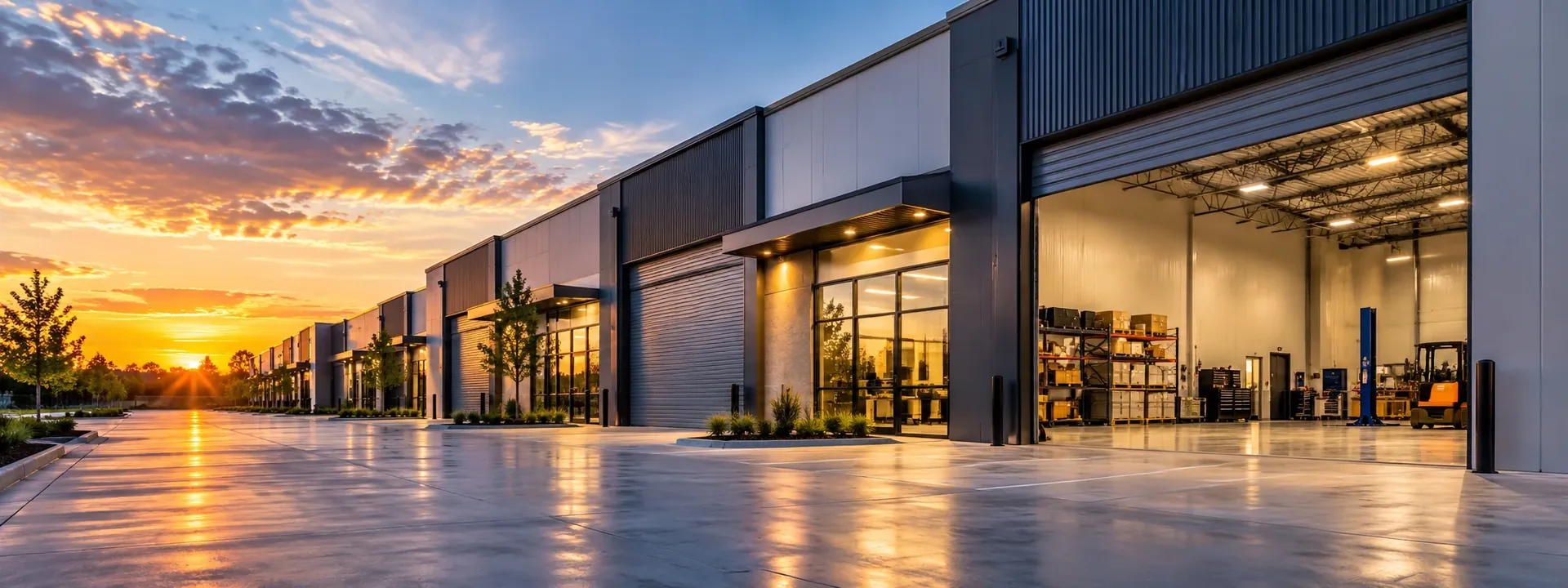
The short version: Small bay industrial is multi-tenant warehouse space split into units of roughly 1,000 to 10,000 square feet, each with its own drive-in door, power and usually a small office. It leases to contractors, trades, service companies and local distributors. Demand is steady and little new supply gets built, which makes existing buildings strong investments. New construction, though, generally needs rents in the low to mid teens per square foot to pencil.
This is the condensed version. The full guide, with 44 owner and tenant questions, design and fire-code issues, lease structure, three worked scenarios and eight costly mistakes, lives at passive.investments/small-bay-industrial.
Small bay, flex, light industrial: the same thing?
Mostly. Brokers use the terms loosely. “Small bay” points to unit size, usually under about 10,000 square feet. “Flex” signals more office finish at the front of each unit. “Multi-tenant light industrial” describes how the building is owned and leased. A single property can fairly be called all three.
| Feature | Small bay / flex | Big-box distribution |
|---|---|---|
| Unit size | About 1,000 to 10,000 SF | 100,000 SF and up |
| Clear height | 16 to 24 feet | 32 to 40 feet |
| Loading | One drive-in door per unit | Dozens of dock-high doors |
| Tenants | Many local businesses | One or a few national users |
| What drives rent | Local service economy | National logistics demand |
Why it is so hard to find
The shortage is a construction problem, not a demand problem. Every small bay needs its own door, restroom, meter and demising walls, so it costs more per square foot to build than a bulk warehouse. The tenants are smaller and lenders discount them. Large developers can put far more capital to work with less effort in big-box projects, so small bay gets left to local builders.
The result: while bulk logistics added large amounts of space after 2021 and national industrial vacancy rose to roughly 7% by early 2026, small bay vacancy has generally stayed lower. Existing tenants rarely move, because relocating a shop is expensive, and good units often lease off a sign before they ever reach a listing site.
Who rents it
HVAC, plumbing and electrical contractors, landscapers, auto and equipment repair, cabinet shops, e-commerce sellers, local distributors and small manufacturers. What they need is simple: a door big enough for a van or box truck, enough power for tools, a restroom, a small office and somewhere to park work vehicles.
In many markets, units of roughly 1,500 to 2,500 square feet lease fastest and earn the highest rent per square foot. They also turn over most often, so good owners mix in some 4,000 to 6,000 square foot bays that let growing tenants stay on the property.
Own a Small Bay Building?
Whether you are thinking about selling, refinancing, or dividing an older warehouse into bays, text Carson to talk through the numbers.
What it costs to build, and the $8 rent problem
As a 2026 planning range, a pre-engineered metal shell runs about $65 to $85 per square foot installed. Add sitework, utilities, doors, restrooms, office finish, soft costs and financing, and complete small bay projects commonly land in the low to mid hundreds per square foot before land. Sitework and utility extensions swing the total more than the building does.
Work backward from rent and the problem is obvious. At $8 per square foot NNN, a 20,000 square foot building earns about $160,000 a year. At an 8% target yield on cost, the whole project, land included, has to come in near $2 million, or $100 per square foot. Very little new small bay can be built for that. That is why low-rent markets see existing buildings change hands, not new ones go up.
Two ways the numbers can work
| Ground-up, 12 bays | Divide an older warehouse | |
|---|---|---|
| Size | 24,000 SF, twelve 2,000 SF bays | 30,000 SF into ten 3,000 SF bays |
| All-in cost | About $3.61M (~$150/SF) | $2.1M purchase + $750K work = $2.85M |
| Rent | $14/SF NNN | $11/SF NNN (was $6.50 single-tenant) |
| NOI after vacancy | About $294,500 | About $291,900 |
| Yield on cost | About 8.2% | About 10.2% |
Run the ground-up building at $8 rents and NOI drops to about $160,600, a 4.4% yield on cost. The conversion wins because the building already exists below replacement cost. These are simplified illustrations, not projections for any property.
Quick answers
Is small bay industrial a good investment?
Usually, when bought at a sensible basis. Light industrial and flex buildings have recently traded around 6.5% to 8.0% cap rates, above infill bulk distribution, with diversified local tenants and limited new competition. The trade-off is more management: many small tenants mean more billing, maintenance calls and leasing.
Are small warehouse leases triple net?
Many are. The tenant pays base rent plus its share of taxes, insurance and common area costs, and its own separately metered utilities. Some owners use modified gross leases for very small units to keep billing simple. Buyers should check whether “NNN” leases are quietly gross.
Can a fire marshal require sprinklers if tenants park trucks inside?
Yes. Under the model codes many jurisdictions adopt, storing commercial vehicles can trigger sprinklers once a fire area exceeds about 5,000 square feet. Owners plan around it with fire walls, sprinklers from day one, or lease limits on vehicle storage. Ask the fire marshal before the design is final.
Is building better than buying?
Only where local rents produce a yield on cost well above market cap rates. Where they do not, buying an existing building, or dividing an older warehouse, is usually the better trade. For construction pricing, see Warehouse Construction Cost.
Read the full guide: What Is Small Bay Industrial, and Is It a Good Investment? — 44 questions on leasing, design, sprinkler triggers, construction bids, conversions and investment returns, plus three scenarios with the full math.
Running Numbers on a Small Bay Deal?
Rents, unit mix and lease-up pace move the result more than the construction bid. Text Carson for a second look at a purchase, conversion or new build.
Disclaimer. This page is general information about industrial real estate and is not legal, tax, engineering or investment advice. Costs, rents and cap rates are general 2026 planning ranges that vary by market and site, and the scenarios are simplified illustrations, not projections. Confirm specifics with local contractors, your lender, attorney and CPA. Passive Investments is a commercial real estate brokerage.